Before
Selected work
AIT USA Institute · Embedded technology partnership
From scattered data and missed leads to one CRM the team uses every day.
AIT USA Institute offers English classes in New Jersey, online and in hybrid formats, alongside other learning programs. The CRM views here focus on AIT USA, the education division: student inquiries, enrollment follow-up, classes and attendance. DENEGRI's work connected two parts of that experience—the team's custom CRM and the public website for prospective students.
AIT describes its history and New Jersey locations on its official website. The implementation account is DENEGRI’s firsthand project evidence. The CRM screenshots below illustrate workflows using a representative public demo with fictional records; they are not production captures or evidence of customer results. The time saved is client-reported; it is not an independently measured benchmark or a forecast for another business.
- Client
- AIT USA Institute
- Relationship
- Long-term collaboration
- Role
- Embedded technology partner
Reported operational impact
1–2 hourssaved per employee, per day01
The starting point
The business had demand, history, and a committed team. Its systems could not keep up.
The original request was a data problem and a lead problem. A closer look showed that critical work was spread across spreadsheets, website platforms, ad accounts, inboxes, and personal phones—with no dependable connection between a customer inquiry and the team’s follow-through.
- 01Tens of thousands of rows spread across bulky, inconsistent Google Sheets
- 02Years of Wix inquiries without dependable follow-up, disconnected from daily work
- 03Limited visibility into follow-up, employee activity, classes, and attendance
- 04Outdated websites, personal phone lines, and fragmented business communications
02
How it changed
The advice, build, training, and follow-through stayed with one accountable partner.
The CRM was shaped with the people who know the business: make the hard product decisions, build around the way the team works, train everyone who uses it, and keep refining what ships.
What DENEGRI built
One tailored CRM
PostgreSQL · automation · tasks · notifications · training · QAAfter
A system the team uses
Live data · accountable follow-up · daily adoption · management visibility03
What changed
Technology built around the business—not the other way around.
Multiple locations, business units, staff responsibilities, and customer paths had to remain clear inside one shared system.
CRM & team workflows
A purpose-built system shaped around multiple locations, business units, staff roles, and the daily realities of the team.
Data foundation
Wix history and spreadsheet records were consolidated and cleaned, with a flexible PostgreSQL data model shaped around the team’s needs.
Lead accountability
Website forms and campaign leads now enter the CRM automatically, with tasks, notifications, pipeline views, and follow-up oversight.
Management visibility
Role-aware views give administrators and senior coordinators a clearer picture of activity, classes, attendance, and open work.
Communications infrastructure
Business phone workflows were modernized so staff could use accountable company channels instead of personal devices.
Digital presence & support
AIT USA Institute and AIT Signs received website improvements alongside account recovery, campaign support, training, QA, and ongoing technical leadership.
04
Operational impact
Less clerical drag. Fewer blind spots. A system the team actually uses.
The strongest immediate result is time returned to the staff. Additional measures—including response speed, recovered opportunities, follow-up completion, and conversion influence—are now measurable inside the CRM.
reported time saved per employee, per day
for day-to-day CRM work across the employee team
lead ingestion from active digital sources
into tasks, pipelines, classes, attendance, and activity
Evidence standard
CRM examples use fictional people, records, and metrics. They illustrate workflows without exposing customer data or independently verifying the reported outcomes.05
The CRM work
A custom CRM for the education team.
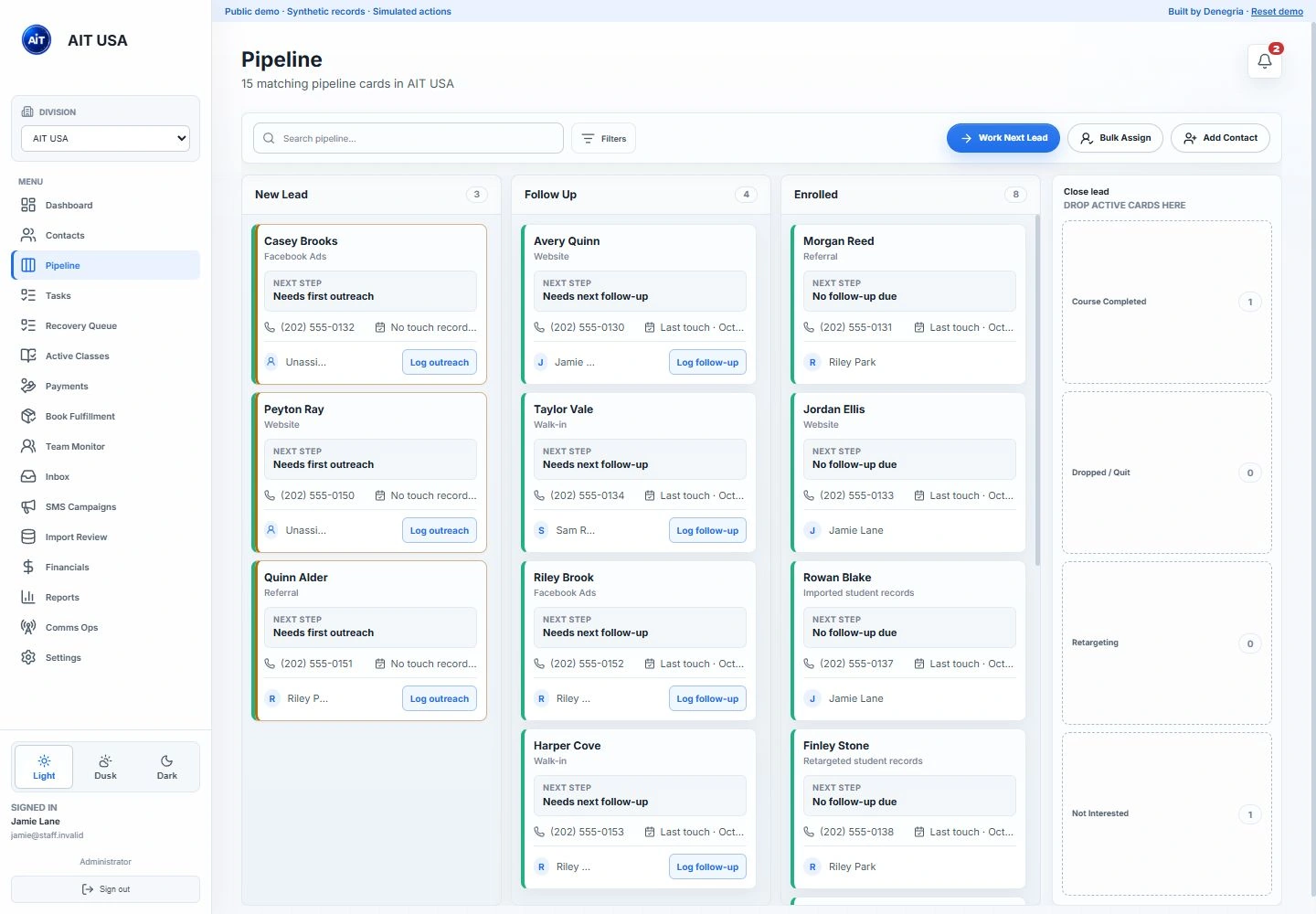
The custom CRM replaced scattered manual Google Sheets workflows with one workspace for student inquiries, enrollment follow-up, class records and attendance. In the AIT USA views, pipeline ownership and next steps support admissions follow-up; classes, sessions and attendance controls support daily student administration. Source and coordinator filters, together with the records behind a report, help the team understand what a displayed total represents.
These desktop screenshots were captured on 30 October 2026 from the AIT CRM public demo, which uses the CRM's interface with fictional data. The visible synthetic-data strip identifies the demo, and actions are simulated in browser memory. All people, records, counts, and rates are fictional. These workflow examples are not a pixel comparison against private production records or a measurement of customer results. Select a CRM image to inspect it at full size.
Lead pipeline · Demo
The USA pipeline has three active stages and a separate closed-outcomes rail. Cards show fictional next steps, ownership, touch history, and outreach actions.
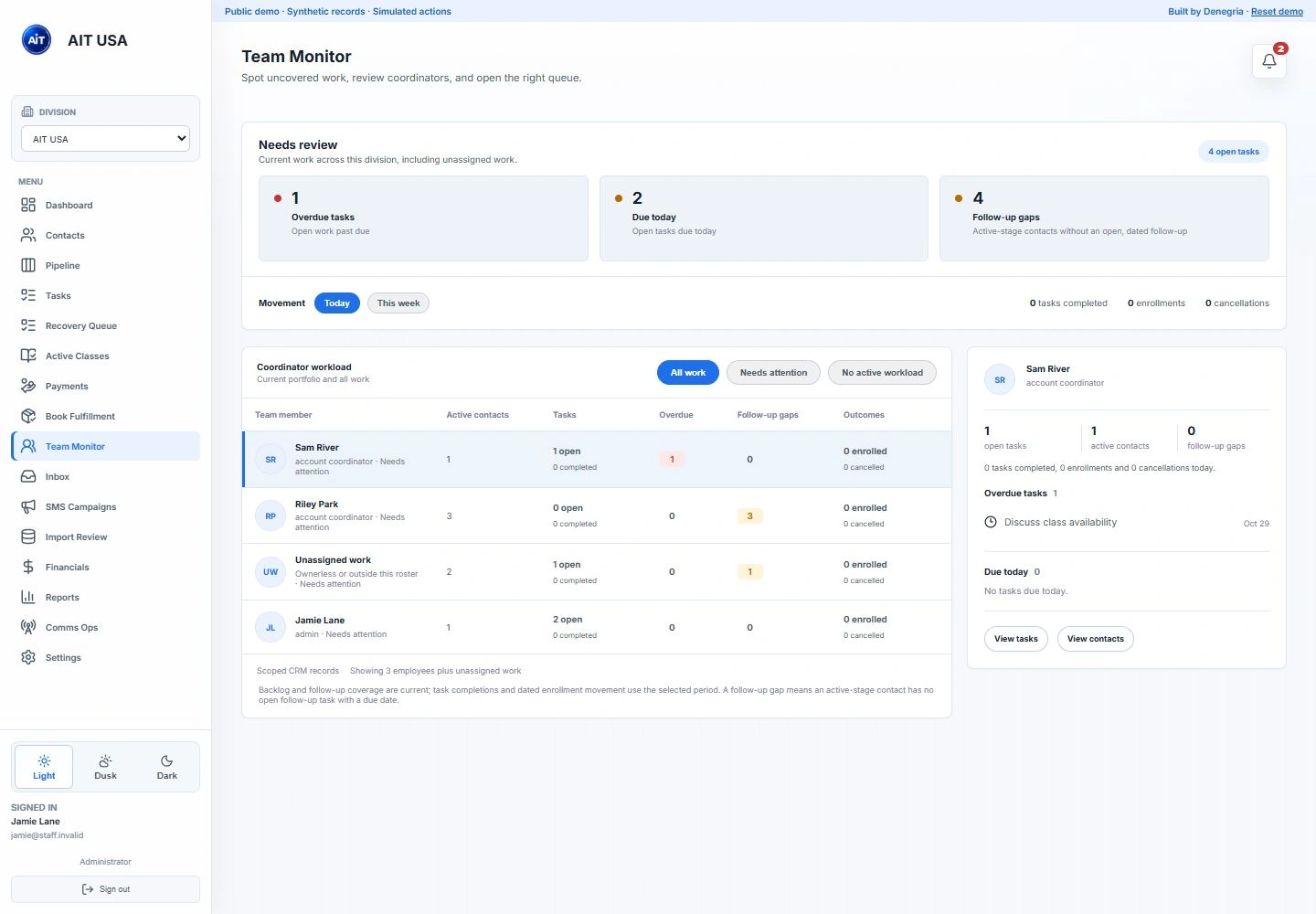
Team Monitor · Demo
The workload overview, coordinator table, and selected queue illustrate overdue tasks, due work, and follow-up gaps using fictional records.
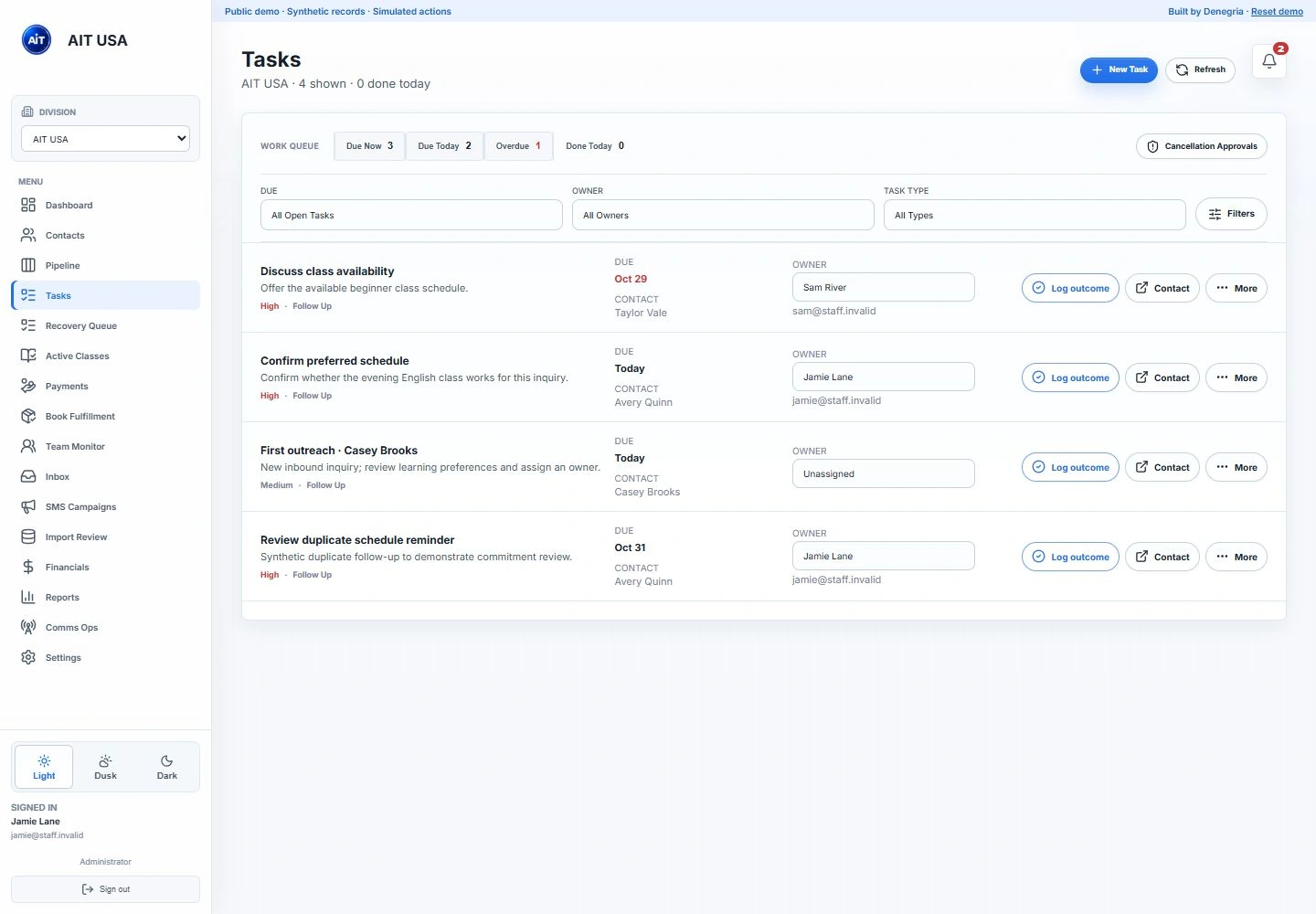
Task accountability · Demo
Fictional follow-up tasks illustrate due dates, ownership, priority, and work still needing an owner.
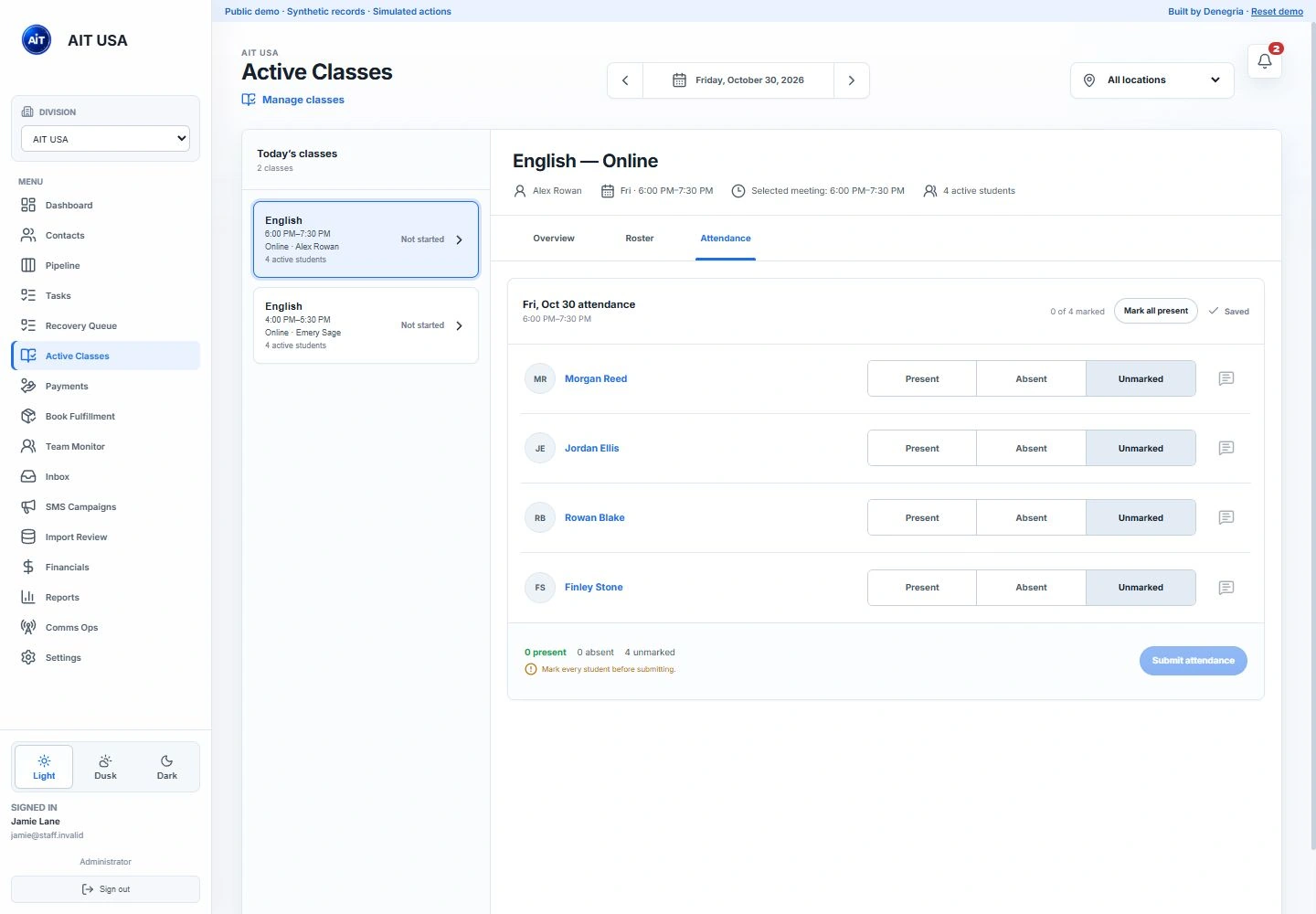
Classes and attendance · Demo
The October 30 class workspace shows a fictional four-student roster with unmarked attendance. The source interface includes session selection, attendance notes, and submission controls; no marks were submitted for this capture.
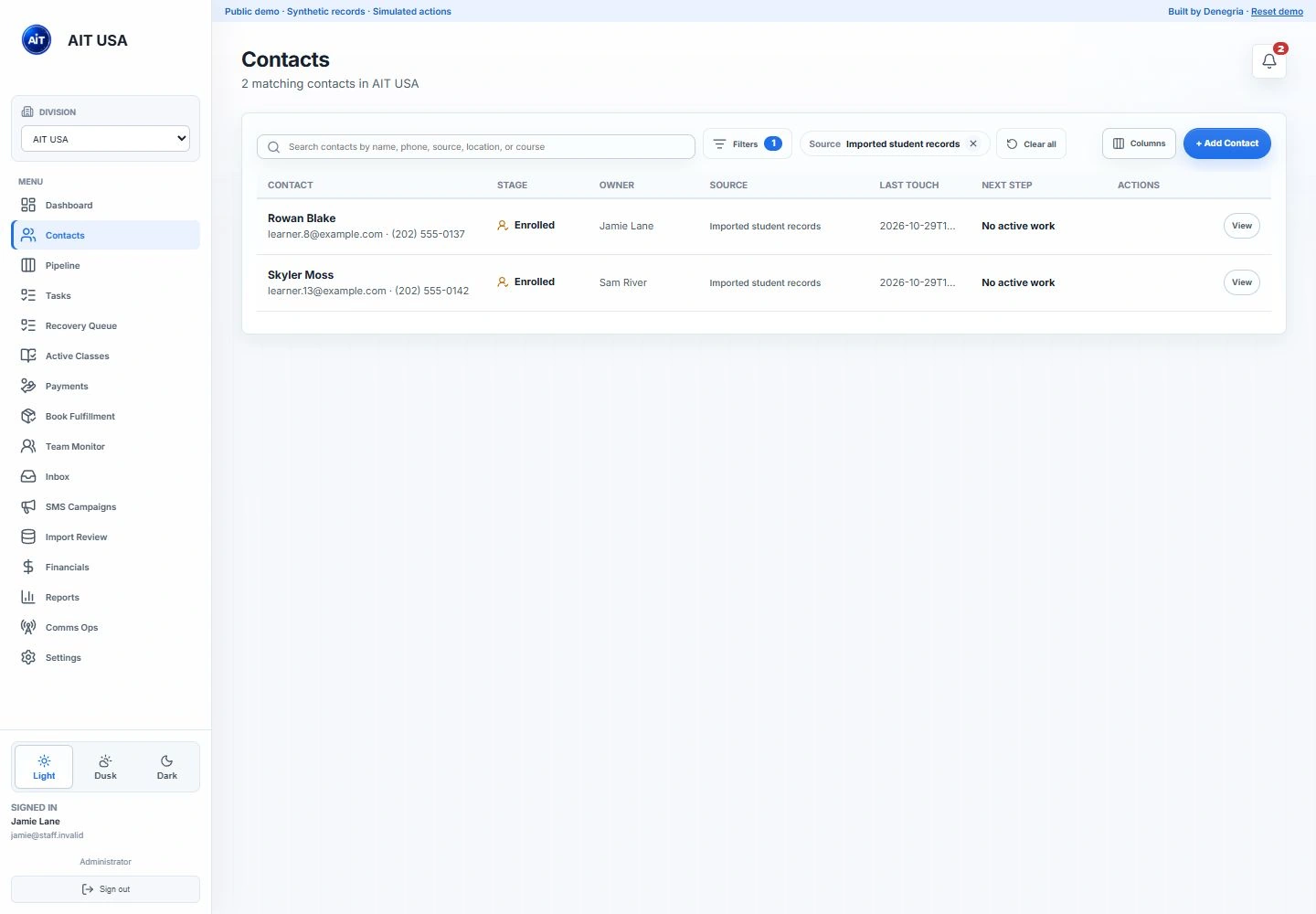
Imported-source contacts · Demo
A fictional cohort illustrates the imported-student source filter, lifecycle stage, ownership, and next action. Refreshed on 30 October 2026.
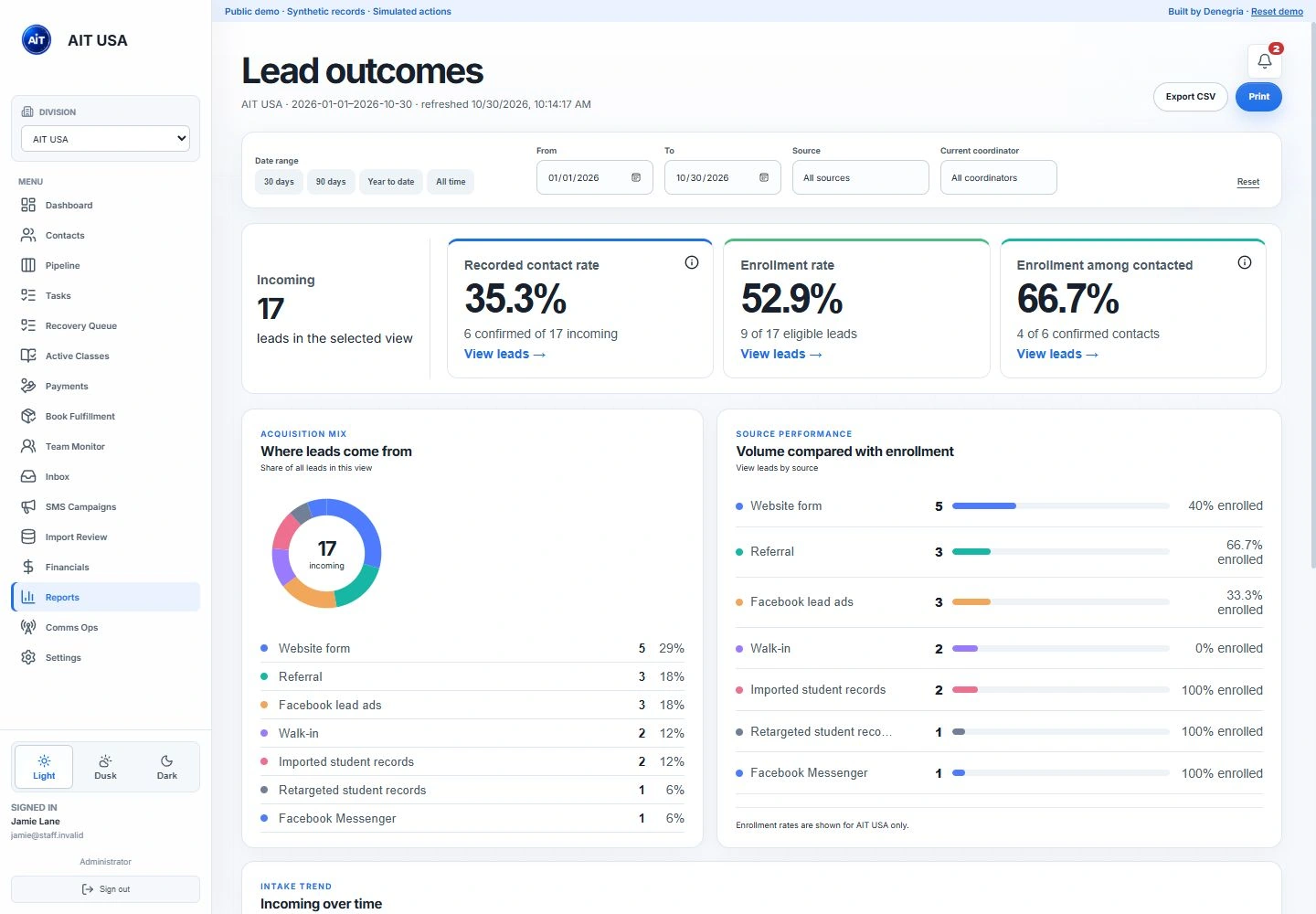
Lead outcomes · Synthetic demo
Date, source, and coordinator filters scope the illustrative report. Every displayed count and rate is fictional and does not measure AIT’s customer results. October 30 demo snapshot.
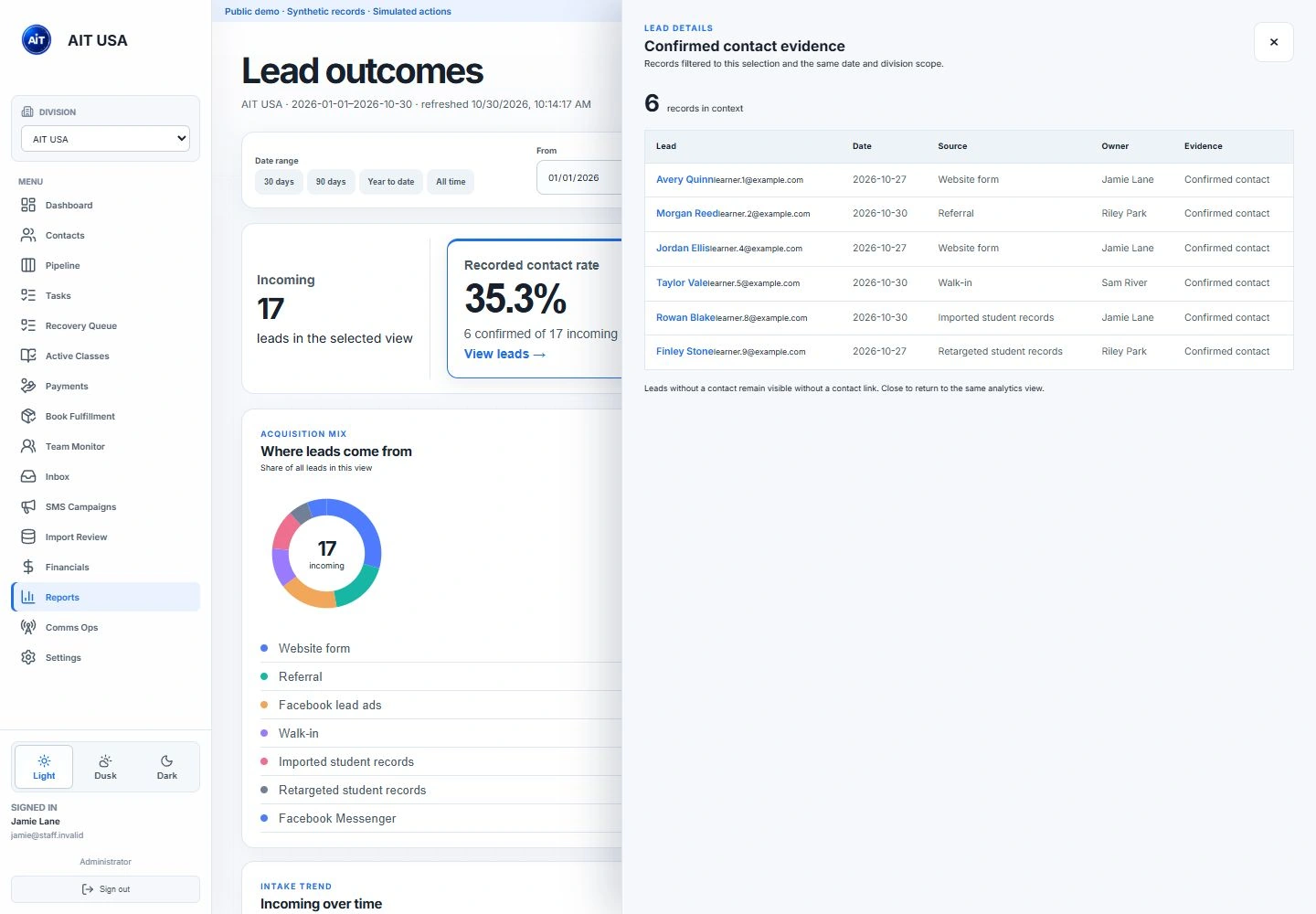
From a metric to its records · Demo
The demo’s View leads action opens the fictional records supporting the selected metric while preserving its date and division scope. No real student records are shown.
06
The website work
Rebuilding the public website for prospective students.
The website rebuild addressed more than inquiry handoff. Broken links, duplicate forms, unclear navigation and user flow, weak content hierarchy, inconsistent layout and imagery, and lost inquiry data made the site harder to use and maintain.
DENEGRI rebuilt the public-facing website with clearer page structure, navigation, imagery and program information, while consolidating inquiry entry points and connecting them to the team's follow-up. Prospective students can compare English study formats and find placement assessment, enrollment and admissions guidance.
The image below shows the actual Spanish-language production homepage, captured on 30 October 2026. Explore the current AIT USA Institute website for its published programs and entry points.
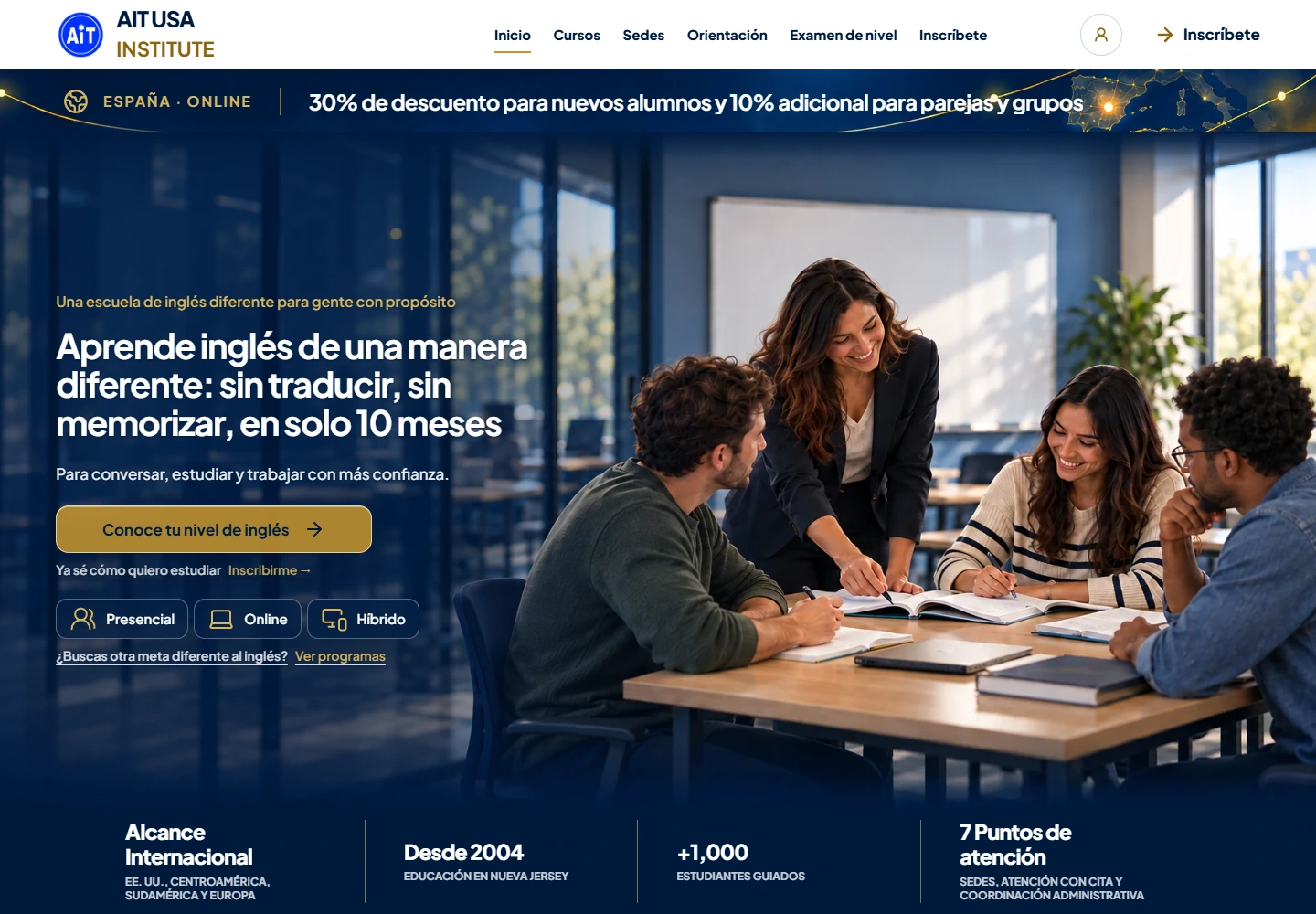
Public website · Homepage hero
Actual Spanish-language production homepage hero, captured on 30 October 2026. It presents the school and its placement-test and enrollment entry points; the visible España · Online banner is part of the live view.
Why the partnership works
Close enough to understand the team. Technical enough to build what it needs.
AIT does not receive a detached recommendation and a handoff. Ownership and staff work with one accountable person who can understand the problem, explain the tradeoffs honestly, implement the solution, train the team, and stay present as the next need appears.
That continuity turns a collection of vendors and tools into technology the business can rely on.
Explore multi-location systems integration07
Owner perspective
“Alvaro is one of the very few people I trust when it comes to our business and technology. He doesn’t just tell us what to do—he sits with the team, listens, finds the real problem, and makes the solution work. When something needs to get done, he is there. He brings ideas we would not have seen on our own, tells me the truth, and keeps pushing until the system works for everyone. For AIT, he has become the person we rely on for anything technical.”
Start with the problem
Where is disconnected technology slowing your team down?
Bring the spreadsheets, missed handoffs, outdated systems, or growth plans. The first conversation is about understanding the problem and choosing a practical place to begin.